You are here
Latest Research: Testosterone
Latest Research: Testosterone
When it comes to testosterone, people tend to think immediately of men and of masculinity. They think of testosterone as a primarily male hormone, as the key to predominantly male traits like upper body strength and beard growth and aggression. And as an androgen, testosterone is generally understood to influence the development of male-typical features. But what about the role it can play in women?
And placing its connection to masculinity aside for the moment, there's now testosterone's newest role as the "secret to female sexual satisfaction." Doctors and the media alike have been touting testosterone as the exciting cure for "female sexual desire" and, for years now, pharmaceutical companies have been trying to get a version of a "female Viagra" approved by the FDA. It seems that, every few months, we see a new story in the media about the latest, testosterone-based answer to low libido. Do women struggle with low libido because their testosterone levels are so low?
The truth of the matter is that we don't know as much about testosterone as we think we do and, in fact, the various limitations of the scientific studies that do exist only exacerbate this.
In pursuit of the latest in testosterone research — and of the origins of many of our preconceived notions on the topic — I chatted with Dr. Sari van Anders, Ph.D., an assistant professor and researcher at the University of Michigan – Ann Arbor whose focus of study is hormones and intimacy in a social context.
Before diving into the million dollar question (will testosterone "cure" me?), van Anders shared some interesting history on testosterone research. Apparently, the way in which certain hormones were first isolated affected the direction most subsequent scientific research took. And in the case of testosterone, these hormones were first isolated in men's urine, and in male animals. Because of this, there was a lot of excitement early on that scientists had isolated the cause of maleness.
But the truth of the matter is that though testosterone is implicated in the development of male-typical characteristics, it's also implicated in things like metabolism, immunity, health, cardiac function, energy, and a whole range of other things present in both men and women. Because while males do have more testosterone in their systems, produced primarily in the testes but also in the adrenal glands, women also produce a moderate amount of testosterone in their ovaries and adrenal glands. But testosterone as it relates to males is now where most scientific research has focused and, according to van Anders, this represents what is an ongoing narrowness of focus within the scientific community.
And this isn't the only area in which our knowledge is limited. When asked how testosterone changes in both men and women with age, van Anders notes that we don't really know. Why? There have been far more cohort studies done on testosterone levels, versus longitudinal studies, meaning that we often look at what groups of individuals look like at different ages instead of actually following one group of people over time.
In addition, our knowledge is also mostly derived from studies of western men, which can have an effect on the studies' results for many reasons. For example, in America, testosterone levels can be artificially inflated because of high protein consumption, in addition to other nutrition- and activity-based factors. So while it seems that testosterone decreases in age with both women and men here in the West, some biological anthropologists have found that older and younger men in other cultures have similar testosterone levels.
Still, testosterone has been getting a lot of attention lately, especially by pharmaceutical companies trying to develop cures for hypoactive sexual desire in women, or low testosterone levels in men. So what's the final word? Can testosterone creams and patches close the gap between incompatible libido levels?
It's hard to say, despite many news articles over the past few years claiming the official discovery of The Female Viagra. There have been many studies on this topic, but no meta-analysis done in order to find patterns within the already-existing research. Not only that, but many studies lay out completely different measures of and definitions for sexual desire and/or sex drive. Some scientists look at the frequency of sexual behavior in a woman's relationships. Some scientists look at desire. Some scientists even look at the pleasure women experience during sex. And some look at a whole range of measures, highlighting a significant finding among a background of null effects. As valuable as it may be to look at all of this, it prevents consistency between studies.
And even though studies do tend to show an effect of some sort on sexual desire — however it happens to be defined at the time — that effect seems moderate, especially considering the doses being given.
Another reason for skepticism is that very few of these studies have included other variables, so it's hard to know whether the effect of testosterone is direct, or whether it's showing a level of effectiveness because of the way in which it affects other functions in the body. For example, maybe women feel more energy when using testosterone, which then translates to sexual activity. So, by that logic, couldn't they just exercise more, an activity that also boosts energy?
Still another cause for pause is that researchers like Cindy Meston and the other folks at the Sexual Psychophysiology Laboratory have shown that research subjects can be very susceptible to the placebo effect when it comes to reporting the effects of medicines on sexual functions.
Finally, a lot of this research is being funded by pharma companies. That doesn't necessarily mean it's not good research, but studies show that these studies are more likely to show positive effects than studies not funded by pharmaceutical companies. Perhaps because people are more invested in finding something. And perhaps people subconsciously make choices that end up bettering their chances of finding what they're looking for.
"I think the people studying this are quite convinced that testosterone affects sexual function," says van Anders. "The skeptics are equally convinced it doesn't. Those of us in the middle feel like the research is still equivocal because of methodological issues."
In the meantime, doctors continue to prescribe testosterone supplements to women off-label. Still, all of this begs the question: what makes a clinical population of women with low desire?
Many women who don't consider themselves to have a problem are deemed as having low desire. But how? Is this an issue of women not being sexual enough for their male partners? Is it a problem of expectations within their relationships? And if so, does this make it a medical problem? A social problem? Health-related? Wellness-related?
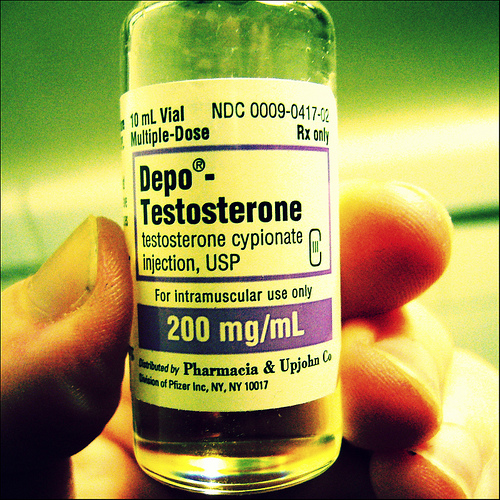
And women aren't the only ones being targeted by pharmaceutical companies. Testosterone supplements have also been prescribed for "testosterone deficiency" in men. But what does testosterone deficiency mean? When testosterone levels are shown to be low, what is it considered low in relationship to? After all, some research shows that testosterone fluctuates by season, by day, or even by diet. In addition, we each differ on an individual basis as to what our testosterone levels are. So when one is diagnosed with testosterone deficiency, are they low as relative to someone else, or low in comparison to what their levels typically are? The truth is, no norms have been scientifically founded.
When it comes to both women and men, words like "dysfunction" or "deficiency" can be problematic. Dipping testosterone levels — and dipping libido levels — are most likely a natural property of aging. "Yet there's been this creeping medicalization of women's and men's bodies," says van Anders. "Instead of seeing menopause as a process women's bodies go through, for example, we see it as a medical emergency. Instead of seeing sexual desire fluctuations as something to be expected throughout our life, we see it as an issue."
Van Anders concludes our conversation by telling me that "despite us all thinking we know everything there is to know about testosterone, there's actually very little scientific research." When I ask her what drives her research, she says, "I like to look in places people aren't looking very much. So much of the research is guided by gendered stereotypes. It's really exciting to do work that doesn't rely on those stereotypes. In our research with testosterone, we're asking questions that don't get asked."
She sees a lot of room for growth within the realm of testosterone research. "People think testosterone is a closed book and that we know everything there is to know. We're just at the start. We hardly know anything."
Latest Research is a new, regular column in Contemporary Sexuality that looks at the latest evidence-based research on a single topic. For those sexual health professionals who often hear the same questions over and over, and don't know how to respond, Latest Research will be a space where one can seek out those answers. If you are a sex educator or other sexual health professional with questions you feel science has not yet addressed — or addressed well — please send them along to steph.auteri@gmail.com for possible inclusion in a future column.
(article image via)